
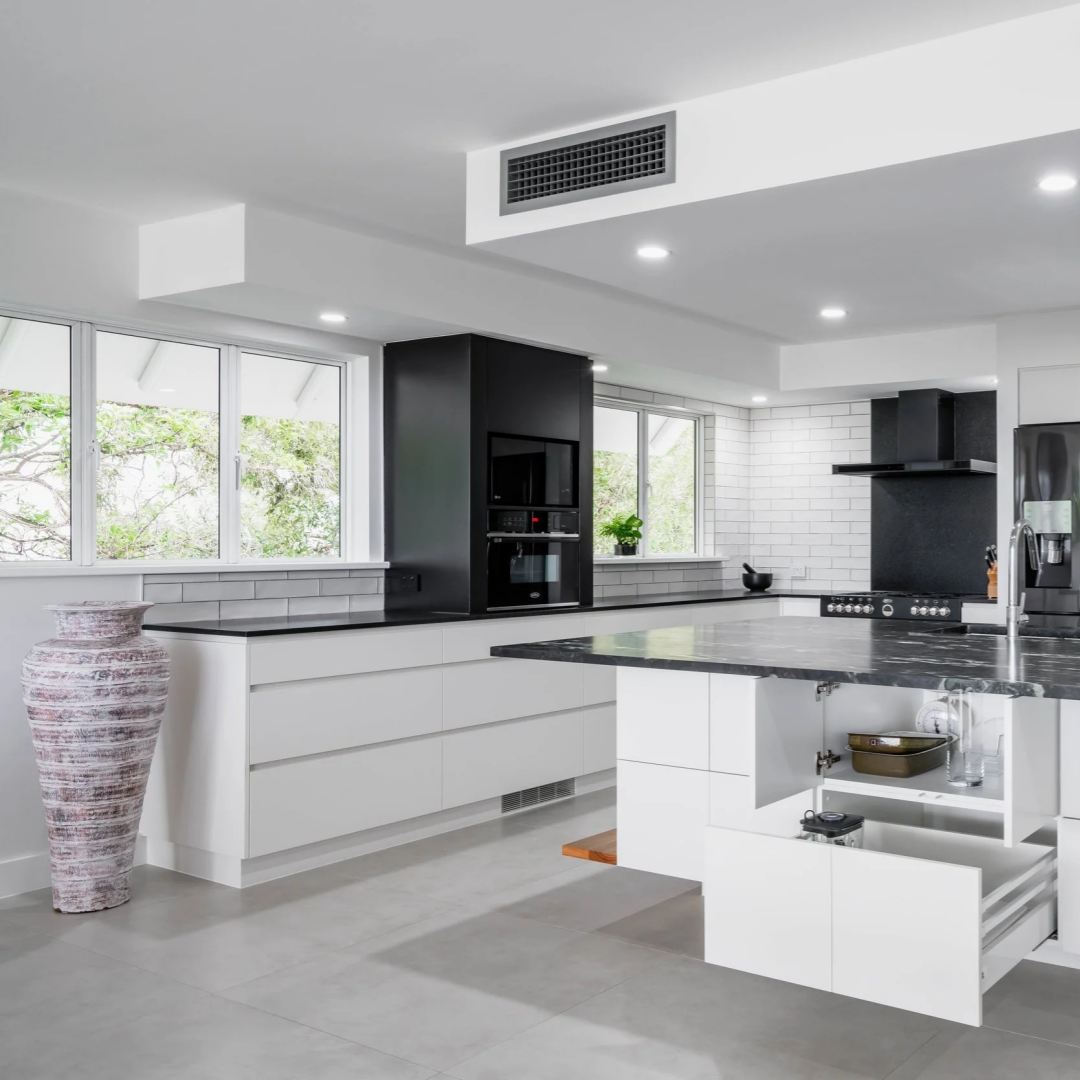
For any villa owner or luxury homeowner, the kitchen is the heart of the project. It is also the most expensive, complex, and technically demanding room to renovate.
When building a high-end home, local quotes for custom joinery can be eye-watering. European brands charge a premium for the label, even though the underlying materials often come from the same global supply chain.
This is why smart homeowners are turning to kitchen cabinets from China.
As sourcing experts based in Foshan and Guangzhou, the global center for building materials, we help homeowners bypass the retail markup. We connect you with factories that produce export-grade cabinetry for the world’s leading developers.
However, sourcing a kitchen requires knowledge. You aren’t just buying a product; you are manufacturing a system. This guide will walk you through the materials, finishes, and hardware you need to know to ensure your Chinese kitchen rivals the best in Europe.
1. The Carcass: The Backbone of Your Kitchen
The “carcass” is the box structure of the cabinet. While you don’t see it often, it determines the longevity of your kitchen. When sourcing from China, you generally have two premium choices:
A. Plywood (The Water-Resistant Choice)
For wet kitchens or humid climates, multi-layered plywood is the gold standard. It holds screws tightly and resists warping.
- Our Standard: We recommend 18mm E1-grade plywood with a moisture-resistant core.
B. Particle Board (The European Standard)
Most high-end European brands actually use particle board (chipboard). However, they don’t use cheap glue.
- The “Egger” Standard: We work with factories that use Austrian Egger Board or equivalent standards. These are high-density, low-formaldehyde boards that are incredibly stable and precise.
2. Door Finishes: Defining the Aesthetic
The door finish is what defines the “look” of your kitchen. In Foshan, the customization options are limitless. Here are the top choices for luxury homes:
High-Gloss or Matte Lacquer (2Pac)
This is the most popular choice for modern, minimalist kitchens.
- The Process: The door is sprayed with multiple coats of paint and baked.
- Why Source in China: Labor-intensive processes like 2Pac are significantly cheaper in China, allowing you to get a “piano finish” for a fraction of the cost.
Wood Veneer
For a warm, natural look. A thin slice of real hardwood (Walnut, Oak, Ash) is adhered to the board and stained.
- Quality Check: We ensure the factory uses “book-matching” techniques so the wood grain flows continuously across your cabinets.
Sintered Stone / Rock Beam
A trending material in 2025/2026. Thin layers of sintered stone are applied to the door face. It is scratch-proof, heat-proof, and looks incredibly high-end.
3. Hardware: The Moving Parts
A kitchen is only as good as its hinges. If the hardware fails, the kitchen fails. This is the #1 fear of international buyers.
Our Rule: No Generic Hardware.
When we source kitchen cabinets from China for our clients, we insist on authentic, imported hardware brands. We do not use “local domestic brands” for luxury projects unless requested.
- Hinges & Runners: We specify Blum (Austria) or Hettich (Germany). These soft-close systems are tested for 200,000 cycles.
- Corner Systems: Magic Corners and Lazy Susans from brands like Kesseböhmer or high-end Chinese equivalents like Higold.
Note: Because these hardware brands have factories in China, we can procure them at wholesale rates directly for your project.
4. The Sourcing Process: From Blueprint to Installation
Sourcing joinery is different from buying a sofa. It requires precision. Here is how we manage your kitchen project:
Step 1: CAD & 3D Design
You send us your floor plan. Our partner factories convert this into a professional CAD drawing and a 3D rendering. We check every dimension—fridge gaps, dishwasher clearance, and island overhangs.
Step 2: Material Selection
We courier a box of physical samples to your home. You can touch the lacquer, feel the wood grain, and test the stone benchtop samples before approving production.
Step 3: Trial Assembly (The Most Important Step)
Before the kitchen is painted and packed, we demand a “White Body Trial Assembly.” The factory sets up your entire kitchen in their workshop.
- We check that drawers slide smoothly.
- We verify that corner cabinets align.
- We send you a video walk-through of your kitchen while it is still in China.
Step 4: Packing & Shipping
We use “flat packing” to save shipping space or “pre-assembled” packing for easier installation. Every box is labeled by room and unit number (e.g., “Kitchen-Island-Unit 3”) for your installer.
5. Beyond the Kitchen: Whole House Joinery
The beauty of sourcing kitchen cabinets from China is that the same factory can usually handle all your joinery needs.
To maximize your shipping container space and ensure a cohesive design language throughout your villa, we recommend sourcing the following simultaneously:
- Walk-in Wardrobes: Using the same leather and glass finishes.
- Bathroom Vanities: Matching the stone countertops.
- Laundry Units: Utilizing durable moisture-resistant materials.
Conclusion: Luxury is in the Details
You do not need to overpay to get a world-class kitchen. By sourcing directly from Foshan and Guangzhou, you gain access to the same materials and machinery used by top European brands—without the retail markup.
Whether you want a sleek handle-less modern kitchen or a classic shaker style, we are your technical partners on the ground.
Building a villa? Let’s start with the kitchen.
Send us your floor plans today for a complimentary consultation and a preliminary estimate.
Your expert sourcing partners for Whole House Customization in Foshan & Guangzhou.
- Phone: +0086 13560427230
- Email: beatus.sourcing@gmail.com
- WeChat: ColinYeung100
- WhatsApp: +8613560427230