
Let me paint you a picture. It’s August 2025, and one of my clients—let’s call him Mike, a wholesaler in Texas—just got hit with a notice from U.S. Customs. His 40-foot container of crane games, shipped direct from a factory in Panyu, is sitting at the Port of Los Angeles. But it’s not moving. Why? No UL certification. The plug doesn’t meet U.S. standards. And now he’s looking at USD 15,000 in storage fees, a missed Q4 delivery window, and a very angry retail chain waiting for their order.
Here’s the thing: Mike bought those machines from a factory he found on Alibaba. The factory sent him photos of a “UL certificate.” He thought he was covered. He wasn’t.
If you’re reading this, you’re probably planning to import arcade games in 2026—or you’ve already started and want to make sure you don’t end up like Mike. The bad news? Global regulations are getting tougher, not looser. The good news? You’re in the right place.
We are a sourcing agent based right here in Panyu, Guangzhou—the heart of the arcade game manufacturing world. I work with foreign wholesalers and arcade owners every single day. I’ve seen what goes wrong, and I know how to get it right. In this guide, I’m going to walk you through exactly what you need to know to get your games through customs and into your warehouse without the headaches.
1. Why Compliance Matters More Than Ever in 2026
The real cost of non-compliance: When a shipment gets flagged by customs, it’s not just a delay. It’s a cascade of costs:
- Customs fines. In the U.S., the CPSC can fine importers up to USD 15 million for products that violate safety standards.
- Storage and demurrage fees. Hundreds or even thousands per day.
- Destroyed or returned goods. At your expense.
- Lost sales. Missing key seasons can break a business.
- Higher insurance premiums. Future shipments get red‑flagged.
What’s Changing in 2026?
| Market | What’s New in 2026 | Effective |
|---|---|---|
| United States | Florida SB 204: certain amusement machines need Gaming Control approval. Criminal penalties for non‑compliant devices. | July 1, 2026 |
| European Union | RoHS may add restricted substances; CE technical files must be more detailed. | Ongoing |
| United Kingdom | UKCA marking fully enforced; CE not accepted. | Full 2026 |
| Indonesia | IGRS mandatory rating for all games marketed. | Jan 2026 |
⚡ Insurance angle no one talks about: If your machine causes a fire or shock and you don’t have the right certifications, your insurance will likely deny the claim. You’re personally on the hook.
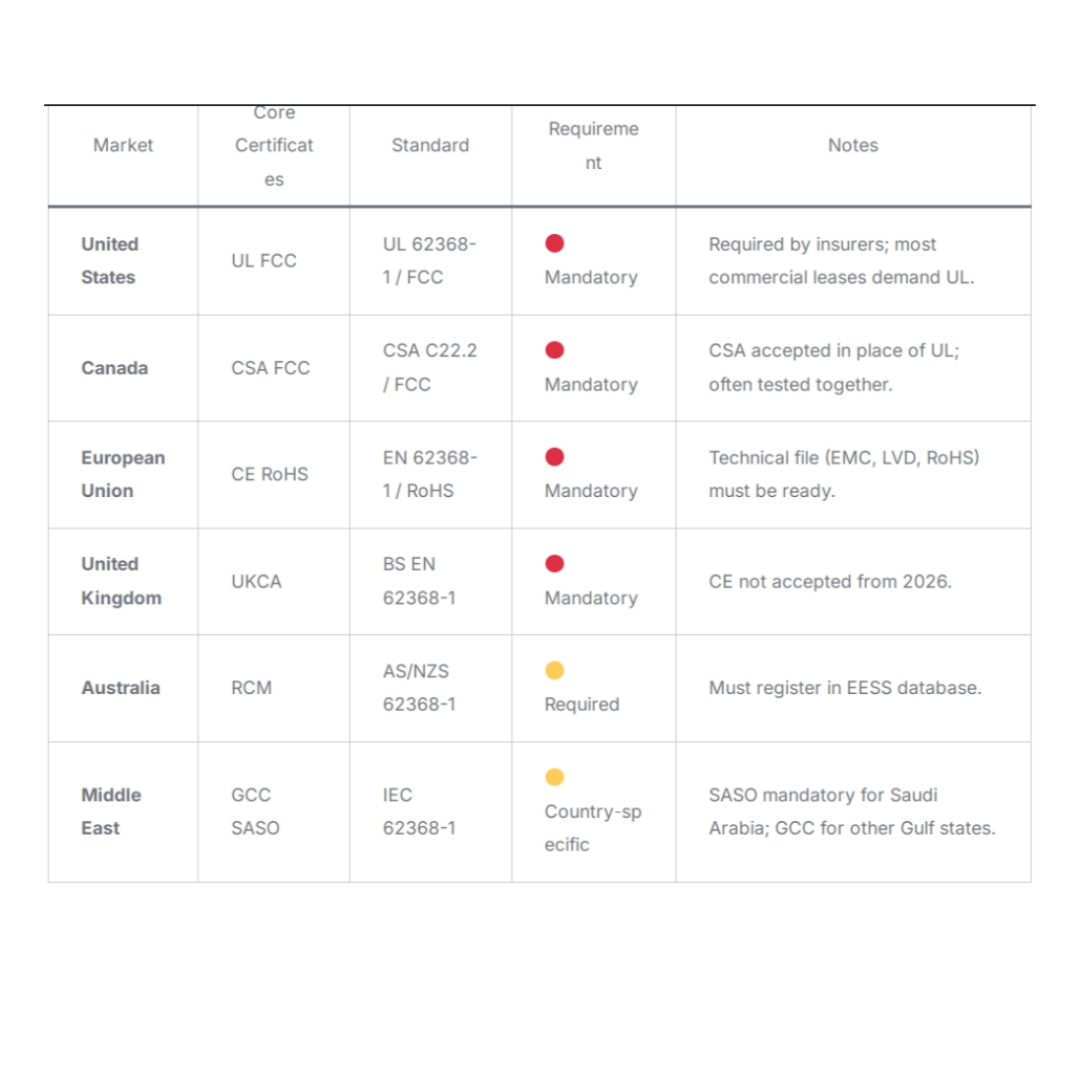
2. What Certificates Do You Actually Need? (Market by Market)
| Market | Core Certificates | Standard | Requirement | Notes |
|---|---|---|---|---|
| United States | UL FCC | UL 62368-1 / FCC | 🔴 Mandatory | Required by insurers; most commercial leases demand UL. |
| Canada | CSA FCC | CSA C22.2 / FCC | 🔴 Mandatory | CSA accepted in place of UL; often tested together. |
| European Union | CE RoHS | EN 62368-1 / RoHS | 🔴 Mandatory | Technical file (EMC, LVD, RoHS) must be ready. |
| United Kingdom | UKCA | BS EN 62368-1 | 🔴 Mandatory | CE not accepted from 2026. |
| Australia | RCM | AS/NZS 62368-1 | 🟡 Required | Must register in EESS database. |
| Middle East | GCC SASO | IEC 62368-1 | 🟡 Country‑specific | SASO mandatory for Saudi Arabia; GCC for other Gulf states. |
North America (USA & Canada)
UL Certification – Underwriters Laboratories. Required for any commercial space (malls, theaters, FECs). Standard: UL 62368-1.
FCC Certification – Electromagnetic interference. SDoC for most games; Certification for radio devices.
CSA (for Canada) – Canadian standard, often tested with UL.
European Union & United Kingdom
CE Marking – Not just a sticker: covers EMC, LVD, RoHS, WEEE. Must have technical file.
UKCA Marking – Separate from CE, mandatory for UK (England, Wales, Scotland).
RoHS 3.0 – Restriction of hazardous substances; frequently checked on cables and PCBs.
Australia & New Zealand
RCM Marking – Covers safety and EMC. Requires registration in EESS database.
Other Key Markets
- Saudi Arabia / Middle East: GCC Mark / SASO – mandatory for most electronics.
- Global (LED/laser games): IEC 62471 – photobiological safety for LED lights and lasers.
3. Customs Clearance 101: Documents You Must Prepare
Pre‑shipment check – do this before the container leaves Panyu:
- Certificate matches the machine (model number on nameplate).
- Certificate is still valid (check issue date).
- Nameplate is correct (voltage, frequency, certification marks).
📦 Step‑by‑Step Clearance Process
- Place Order with Factory
- Pre‑Shipment Inspection – Verify certificates & physical tags.
- Prepare Documents: Commercial Invoice, Packing List, Bill of Lading, Certificate of Origin, Test Reports/DoC, User Manual (local language).
- Ship Goods – Arrange freight.
- Arrival at Port of Destination
- Customs Review – Documents in order? ✅ Pay duties → release; ❌ Hold/fine → contact broker to fix docs → resubmit.
- Delivery to Warehouse
HS Code tip: Arcade games typically fall under 9504.90.10. Misclassification can trigger inspection. Work with a customs broker experienced in amusement equipment.
4. Top 5 Legal Pitfalls When Importing Arcade Games
1. Pirated PCBs
Risk: FBI investigation, criminal charges.
Check: PCB purchase receipts from legitimate suppliers.High impact
2. Wrong Voltage / Plug
Risk: Machines damaged, unusable.
Check: Confirm voltage requirements before production; inspect nameplate.Very common
3. Expired / Fake Certificates
Risk: Customs seizure, fines.
Check: Verify report number, issue date, and model match.Medium impact
4. No Local Language Manual
Risk: EU customs rejects shipment.
Check: Confirm language requirements (EU: local language).Often overlooked
5. “It’s Just a Sample” Myth
Risk: Still gets detained.
Check: All commercial imports need certifications, even small quantities.Misconception
5. How a Local Panyu Sourcing Agent Protects Your Business
I’m based right here in Panyu. I visit factories weekly. I know which ones cut corners and which ones do things right. Here’s how I help my clients avoid the problems above:
- Factory vetting: Only suppliers with proven compliance records.
- Certificate verification: Check report numbers, standard versions, and validity.
- Pre‑shipment compliance inspection: Nameplate, wiring, PCB source, manual language.
- Logistics & customs liaison: Freight forwarders specialized in amusement equipment.
- Real‑time regulation updates: Indonesia IGRS, Florida SB 204, UKCA changes, etc.
6. Frequently Asked Questions (FAQ)
Q: Can I get CE or UL for a used/refurbished machine?
A: Yes, but it must be tested to current standards. Old components may need upgrades.
Q: Do I need certification if it’s for a private club (not public)?
A: Yes. Still connected to grid; insurance will require it.
Q: How long are certificates valid?
A: Some don’t expire, but if the standard updates, the old certificate may no longer be accepted. Review every 3‑5 years.
Q: What if I custom‑build a one‑off game?
A: For commercial use, yes. May be eligible for self‑certification under lab supervision.
Q: How to tell if a factory’s certificate is real?
A: Check the report number and contact the issuing lab. Full report must match model.
Conclusion – Compliance Is an Investment, Not an Expense
One seized container, one missed season, one lawsuit – any of these can wipe out your business. The importers who take compliance seriously sleep well at night. Their shipments move smoothly. Their customers are happy.
If you’re planning a 2026 purchase, or if you have a supplier in Panyu right now and you’re not 100% sure about their certificates, I’d love to help.
Contact our team in Panyu
Free compliance pre‑check on your current supplier or next order.
No obligation. Just straight talk.📩 Reach out now
Have questions about a specific market or product? I’m here to help.
⚡ Beatus sourcing tip: Always request the full test report (not just the certificate) and verify model number, date, and standards. Expired or mismatched certificates = customs delay.